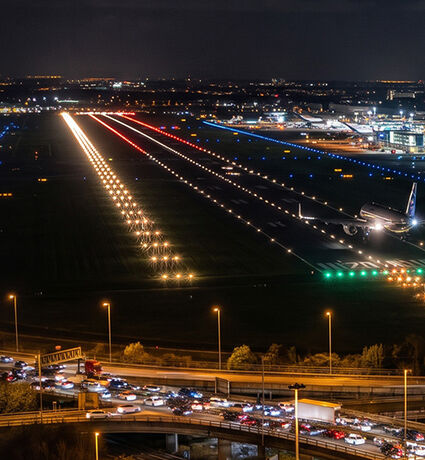

Safety on road, rail, in the air and on water
Traffic signs, signal lights, road and rail traffic signals, road retroreflectors, airfield lighting, aircraft lighting and navigation lights for shipping all contribute to safety on land, in the air and on water. These products are therefore subject to strict legal requirements. Photometric properties play the central role and must be tested precisely and rigorously.


The challenge: Different test objects and measurement conditions
Numerous standards set limits for luminous intensity distribution, luminous color, retroreflection and luminance. To demonstrate conformity, Instrument Systems offers precise, highly efficient goniophotometer systems and a complete range of accessories. This enables conformity measurements in accordance with the following standards, among others:
Product and application standards
- DIN EN 12966:2019-02: variable message traffic signs
- DIN EN 12368:2015-09: traffic signal heads
- DIN EN 12899-3:2008-02; ASTM E809-21; ASTM E810-20: retroreflectors
- SAE AS8037, SAE AS8017; TSO-C30 and TSO-C96: aircraft position and anti-collision lights
- CS 25.1383: aircraft landing lights
- ICAO and FAA: airfield lighting
- SeeSchStrO (Seeschifffahrtsstraßen-Ordnung) and BinSchStrO (Binnenschifffahrtsstraßen-Ordnung): German regulations for sea and inland shipping lanes
- IALA: International Association of Marine Aids to Navigation and Lighthouse Authorities (maritime buoyage system)
- KVR (Collision Regulations) and IEC 60945: ship navigation lights
- DIN EN 14744:2006: navigation lights for inland and sea-going vessels
Measurement standards and instrument requirements
- DIN 5032-7:2017: Classification of illuminance and luminance meters
- DIN EN 13032-1: Photometric measurements and data presentation
- CIE 121:1996: Photometry and goniophotometry of luminaires
- CIE 54.2:2001: Retroreflection: definition and measurement
- CIE 231:2019: Classification of illuminance and luminance meters
The applicable edition and its relevance must be checked for each test program.
LEDs, PWM, variable message signs and traffic control systems
LED technology has also become established in traffic lighting. The commonly used pulse-width modulation (PWM) of light sources places very high demands on the photometers used. Measuring flashing light sources such as warning lights, airfield lighting and obstacle lighting requires a particularly fast photometer that reliably captures the flash profiles. Variable message signs and traffic control systems also require measurement technology that reliably captures their changing display states.
Flashing warning and obstruction lights place specific demands on the temporal response of the photometers. Suitable integration times, synchronization or fast data acquisition are required to reliably capture the prescribed signal and flash characteristics.
High measurement accuracy for varying test objects
Blinking and pulsing light sources require precise sample positioning with a type A goniophotometer, as well as photometers with a broad range of functions. Different sample sizes, angular ranges and electrical operating modes require adaptable positioning systems and measurement sequences. Laboratories that switch between product groups benefit from consistent test procedures that deliver reproducible results. Measurement accuracy, measurement speed and efficiency are therefore the decisive criteria when selecting the right system.
Our solution: AMS and RMS systems for application-specific testing
The AMS goniophotometer systems of the Optronik Line measure the angular luminous intensity distribution of traffic and signal lights. They are based on long-standing experience with traffic and airfield lights and numerous customer projects, and the comprehensive range of accessories extends their range of applications. For the retroreflection of retroreflectors and road safety devices, the RMS retroreflectometers provide the measurement values.
The configuration depends on sample size, measurement geometry, the characteristics of the light source and the applicable test specification. Positioning systems, measuring instruments, power supplies and control software come from a single source.
The LightCon laboratory software controls all functions of the test objects. Measurement rules can be edited flexibly and stored in a customer-specific database. On request, Instrument Systems also supplies a rule database with the required measurement rules. Evaluation and management of measurement results are part of the software.
Control of the test objects, high spatial resolution, simple operation and the comparison of measurement results are included in the scope of supply. Our experts support you with system selection, laboratory planning and project implementation.
Contact us
Planning a new test laboratory or extending existing testing capabilities? Tell us which products and standards you work with, and we can discuss a suitable measurement setup. Contact our experts to get started.
1. Which properties are relevant for signal lights?
Depending on the product standard, tests may cover angular luminous intensity, color, luminance and other optical requirements.
2. Why do flashing lights need different measurement settings?
Their optical output varies over time. The acquisition method must be appropriate for the specified flash behavior and measurement parameter.
3. What is the difference between AMS and RMS?
AMS measures light emitted over different angles; RMS evaluates retroreflection from passive materials and road safety devices.
4. Which standards govern airfield lighting?
Relevant ICAO provisions and, where applicable, FAA requirements define the testing program for the particular airfield light.