
Consistent display colors across different technologies
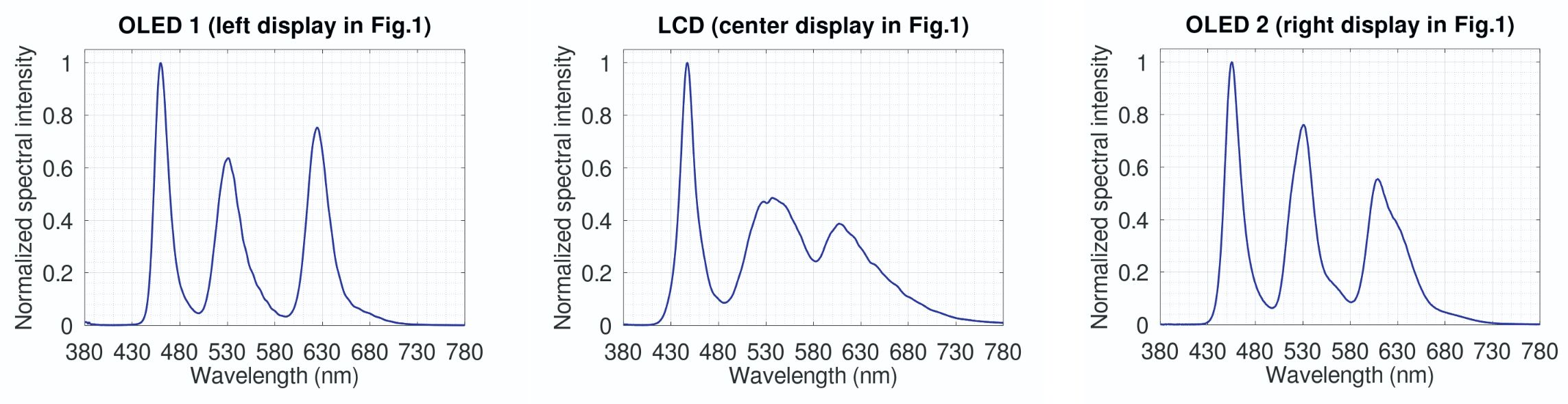
Two displays can have the same measured white point and still appear different. This is particularly relevant when matching OLED, QD-OLED, Mini-LED and MicroLED-based displays with different emission spectra.
Evaluating displays with multiple color-matching functions (CMFs) helps manufacturers to identify potential color differences that cannot be detected using conventional CIE 1931 measurements alone. By comparing results from different colorimetric observer models, manufacturers gain additional information for display calibration, color matching and production quality control.
The challenge: When matching color coordinates is not enough
Conventional display calibration relies on the CIE 1931 standard observer. However, displays with different emission spectra, particularly narrow-band emission spectra, can produce identical color coordinates while appearing different under other observer models.
This effect, known as observer metamerism, presents a challenge when attempting to match colors across different display technologies. For example, an OLED and an LCD display may meet the same white-point specification but show a noticeable color difference when viewed side by side.
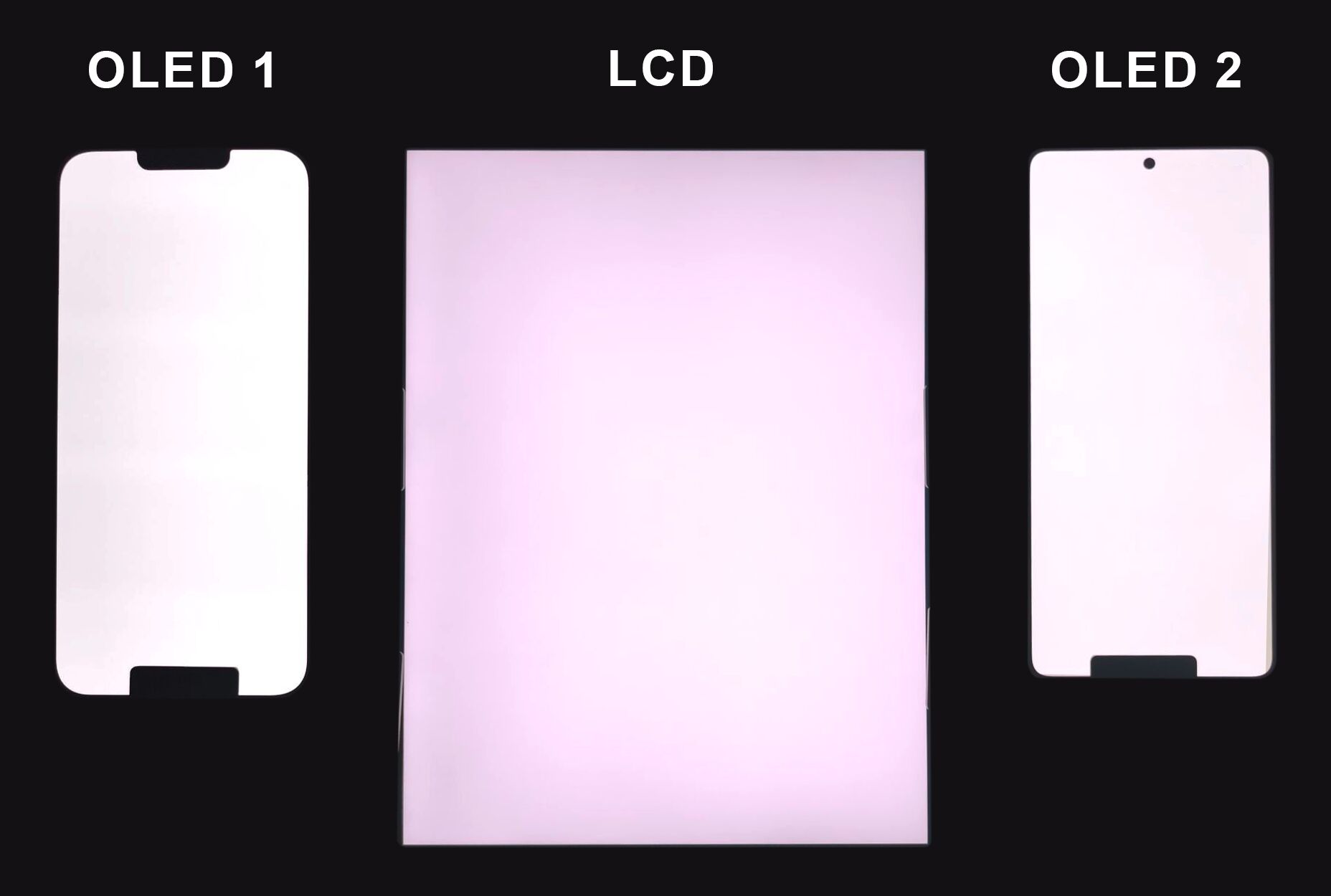
Figure 1: Three displays with different emission spectra — a reference OLED display (left), an LCD display (center), and a second OLED display (right). Although the displays are matched to the same white point using the CIE 1931 2° observer, they may appear to have different colors because of metameric mismatch.

Key challenges include:
- Identifying potential color mismatches beyond conventional CIE 1931 measurements
- Evaluating the influence of different emission spectra on display color matching
- Selecting suitable observer models for specific display applications and target groups
- Comparing results from different colorimetric observer models
- Maintaining photometric traceability when applying alternative color matching functions (CMFs)
Our solution: Spectral display measurement with flexible CMF evaluation
Instrument Systems combines spectroradiometric measurements with flexible color evaluation using multiple colorimetric observers. Manufacturers can evaluate the same measured spectral data using CIE 1931 2°, CIE 1964 10°, CIE 2015 2° and 10°, as well as supported customer-defined observers. This approach helps to identify and quantify model-dependent color differences, investigate observer metamerism and optimize display color matching for different technologies and applications.
Depending on the measurement task, Instrument Systems offers two approaches:
2D display color measurement – LumiTop with CAS and LumiSuite
For spatially resolved display testing, the LumiTop imaging colorimeter combines high-resolution imaging with spectral reference measurements from a CAS spectroradiometer. With LumiSuite and its MyCal functionality, selected CMFs can be applied to camera color calibration and 2D color evaluation. This enables manufacturers to assess white-point differences, color distribution and uniformity across the display area.
This approach supports display development, calibration and production quality control, including applications requiring evaluation with different colorimetric observer models.
1D spot measurement – TOP 200 with CAS spectroradiometer
For color evaluation at selected display positions, a CAS spectroradiometer combined with the TOP 200 optical probe provides spectral measurement data for comparison using different observer models. Using SpecWin Pro or CAS.dll, the measured spectra can be post-processed with standard or custom CMFs to calculate and compare tristimulus values and color coordinates.
This approach is suitable for targeted color matching and display characterization when full-field imaging is not required.
Traceable luminance measurement with multiple CMFs
Alternative observer models provide additional color information without replacing established photometric measurement standards. Standard luminance continues to be evaluated using the photopic luminous-efficiency function V(λ), while additional CMFs are applied to the measured spectral data for color comparison. By maintaining traceability to established photometric standards, manufacturers can reliably compare measurement results across different systems and production sites, while also benefiting from additional observer-specific color evaluation. This supports consistent quality control and informed color-matching decisions.
Looking to improve color matching across different display technologies?
Contact Instrument Systems to discuss suitable measurement solutions for your display development, calibration or production testing requirements.
1. Why can OLED and LCD displays look different despite having the same white point?
OLED and LCD displays can have different emission spectra even when their measured CIE 1931 white-point coordinates match. These differences can lead to metameric mismatch under other observer models. Evaluating the spectra with multiple CMFs helps to identify and quantify potential color differences.
2. What is observer metamerism in display color matching?
Observer metamerism describes a situation in which two emission spectra produce a color match for one observer model but not for another. This is particularly relevant when comparing displays with different spectral characteristics, such as OLED, QD-OLED and MicroLED. Evaluating multiple colorimetric observer models helps manufacturers assess possible color-matching differences.
3. What are color-matching functions (CMFs), and why use multiple CMFs?
Color-matching functions (CMFs) describe how a standard human observer matches colors across different wavelengths. They are used to calculate color values from measured spectral data, linking physical light measurements to human color perception. Since color perception varies between observers, using multiple CMFs helps evaluate potential differences in how display colors are perceived.
4. What is the difference between CIE 1931 and CIE 2015 color-matching functions?
CIE 1931 and CIE 2015 use different spectral sensitivity functions to calculate color values. CIE 1931 remains the established reference for conventional colorimetry, while CIE 2015 provides alternative observer models that can reveal additional color-matching differences, particularly for displays with narrow-band emission spectra.
5. How can multiple CMFs improve display color matching?
By evaluating the same spectral measurement data using different observer models, manufacturers can identify color differences that conventional white-point matching may overlook. These results help them to compare display technologies, select appropriate calibration targets, and make informed decisions about color consistency.
6. How are standardized luminance measurements maintained when using alternative CMFs?
Standard luminance measurements continue to use the established photopic luminous-efficiency function V(λ) and a traceably calibrated measurement system. Alternative CMFs provide additional color evaluation results without replacing standardized photometric quantities.