

Optical Characterization of Light Sources for CPO and NPO
Growing data traffic in AI infrastructure and data centers is driving demand for higher-bandwidth as well as more power-efficient interconnects. Co-packaged optics (CPO) and near-packaged optics (NPO) place optical engines closer to application-specific integrated circuits (ASICs) or even integrate them as part of the ASIC itself. Shorter electrical connections can help reduce power consumption and latency while supporting higher data throughput.
VCSEL arrays are established light sources for optical data communication, while microLED arrays are an emerging approach. Reliable optical characterization helps manufacturers identify emitter-level variations, verify performance requirements and assess array uniformity. Instrument Systems provides measurement solutions from device development to wafer-level inspection, supporting the identification of deviations, process optimization and quality control.
The challenge: Reliable characterization of increasingly complex emitter arrays
As VCSEL and microLED arrays become more complex, manufacturers must evaluate the performance of individual emitters without losing sight of overall array behavior. Total optical output alone may conceal weak or defective emitters, while variations in wavelength, polarization and beam characteristics can affect optical coupling. The challenge is to capture these differences reliably and efficiently, from individual devices to large arrays and entire wafers.
Key challenges include:
- Detecting weak or defective emitters and variations in optical power across arrays
- Evaluating VCSEL operating behavior and efficiency, including pulsed LIV measurements
- Identifying wavelength deviations and non-uniformity in emission spectra
- Assessing near-field, polarization and far-field characteristics relevant to optical coupling
- Inspecting wafers efficiently to identify emission non-uniformities and support yield optimization
Our solution: Emitter-level insights from development to wafer inspection
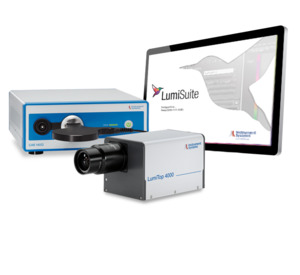
Instrument Systems provides optical measurement solutions tailored to the characteristics of VCSEL and microLED light sources. Combining spatially resolved imaging, spectral analysis and optical power measurements, the systems reveal performance variations that may remain hidden in array-level measurements. Different configurations support characterization throughout development, production testing and wafer-level inspection.
VCSEL characterization
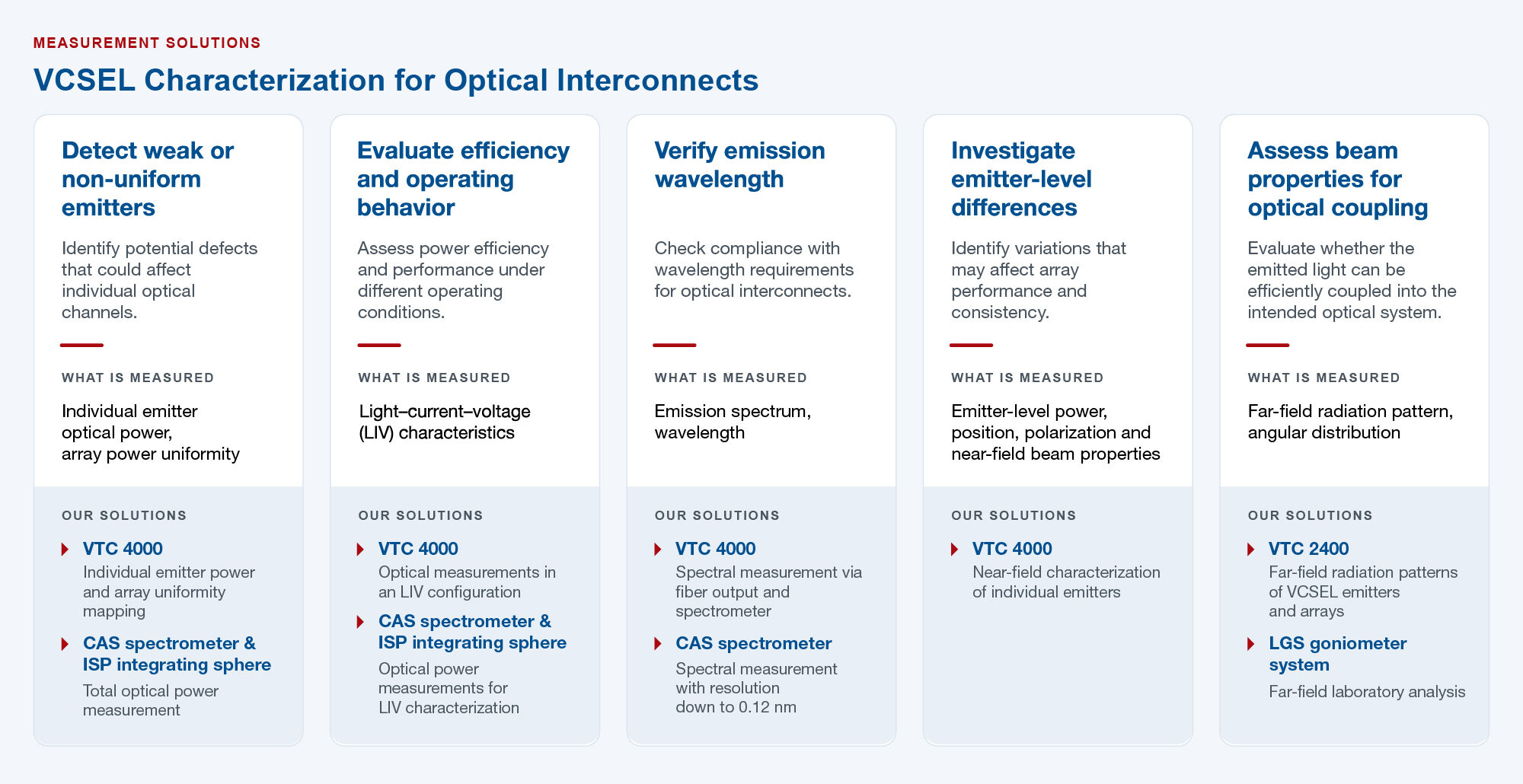
VCSEL arrays used in optical interconnects require consistent emitter performance to support efficient optical coupling and reliable operation. Variations in optical power, emission wavelength, polarization or beam direction can affect how effectively light is coupled into the optical system. Identifying these differences at the individual emitter level helps engineers evaluate array uniformity and optimize device performance.
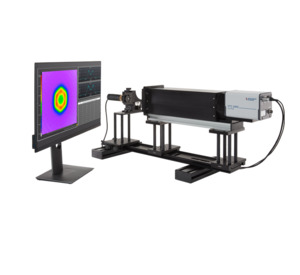
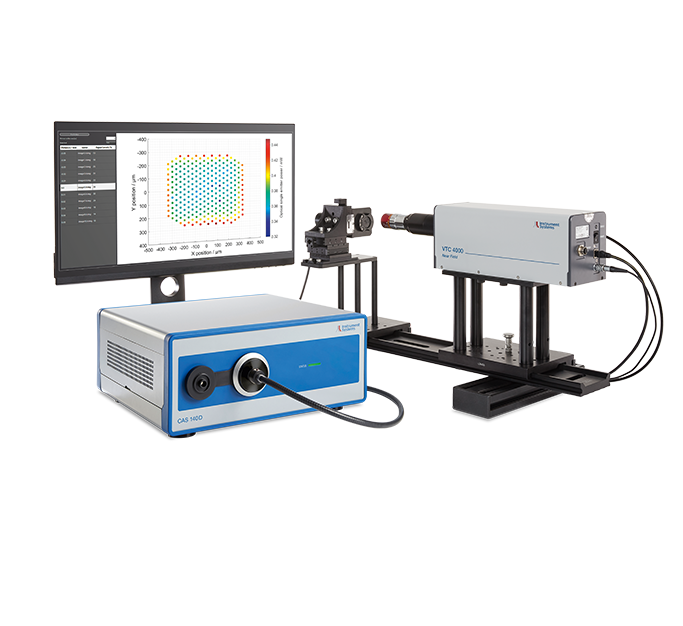
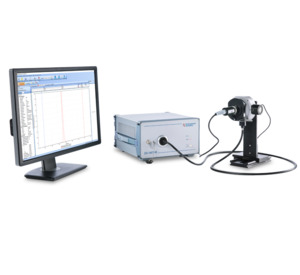
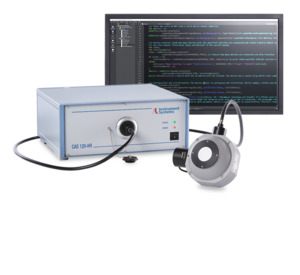
Instrument Systems combines VTC 4000 near-field testing system, VTC 2400 far-field testing system and CAS spectrometers with ISP integrating spheres to characterize VCSEL performance from individual emitters to complete arrays. The measurements provide insights into power distribution, spectral behavior and beam characteristics throughout development and testing.
MicroLED array characterization
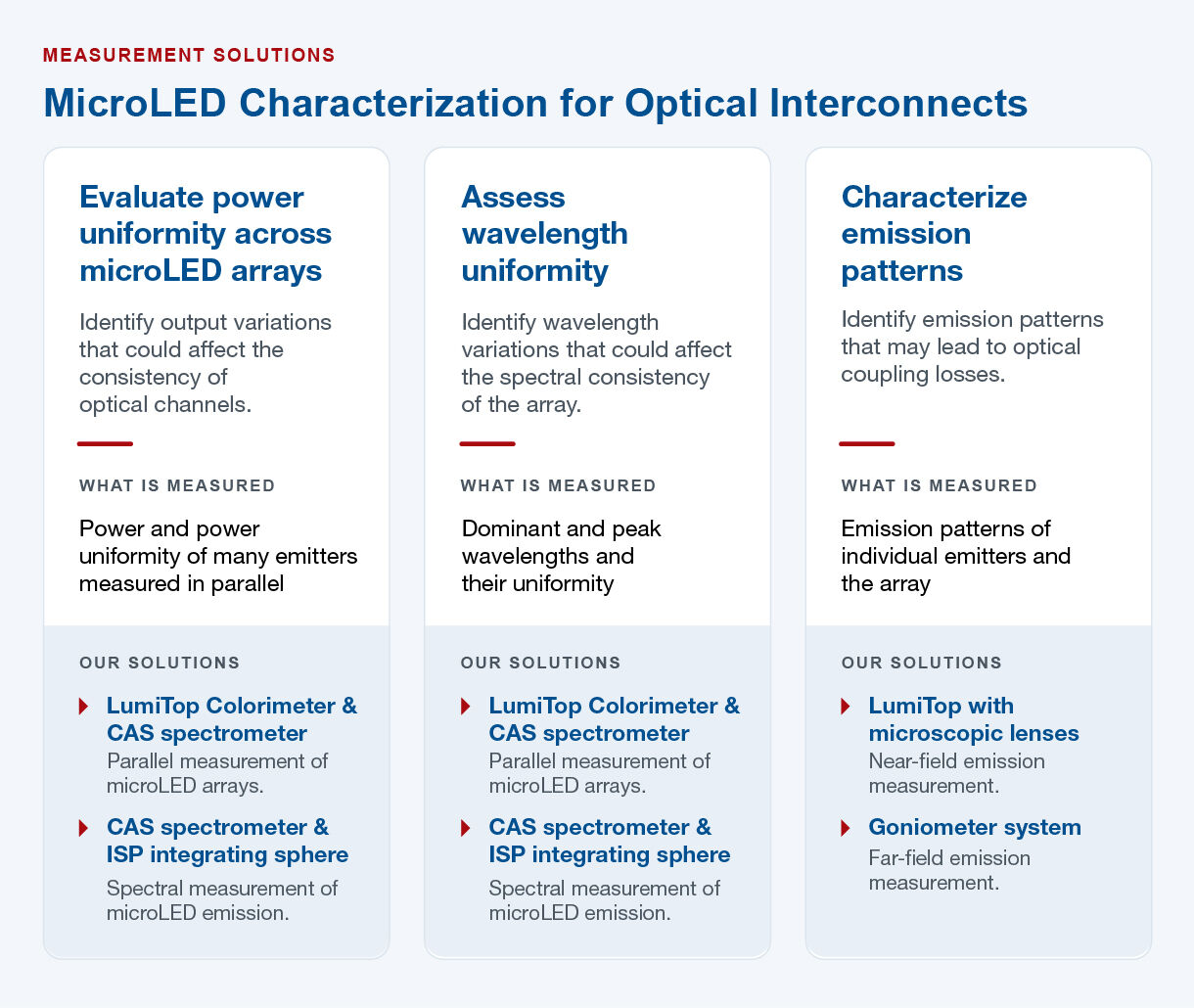
MicroLED arrays are an emerging light-source technology for optical interconnects, with densely packed emitters that require spatially resolved characterization. Variations in optical power, wavelength and emission patterns can affect array uniformity and optical coupling. Identifying these differences helps engineers evaluate individual emitter performance and assess microLED arrays for optical communication.
LumiTop imaging systems with CAS spectroradiometers provide spatially resolved optical and spectral measurements. Combined with microscopic optics and goniometer-based far-field characterization, these solutions support the evaluation of emitter uniformity and emission characteristics relevant to optical coupling.
Automated wafer-level inspection
Developed jointly by Instrument Systems and Rapitech, the RTS system combines automated wafer handling with spectroradiometric and imaging measurement technology for full-wafer microLED inspection.
The system enables fast, non-destructive testing to identify defective emitters and evaluate wavelength, luminance and color uniformity across the wafer. Automated defect mapping and measurement data support process optimization, quality control and yield improvement.
Contact us
Need to identify emitter-level deviations or evaluate light-source uniformity at wafer level? Contact Instrument Systems to discuss a measurement setup for your VCSEL or microLED application.
1. Why is optical characterization important for CPO and NPO light sources?
Co-packaged optics (CPO) and near-packaged optics (NPO) place optical engines close to application-specific integrated circuits (ASICs) to support high-bandwidth data transmission with shorter electrical connections. Optical characterization helps verify that light sources such as VCSEL and microLED arrays meet requirements to ensure reliable, low-power data communication. These measurements provide essential information for evaluating light-source performance in optical interconnect applications.
2. How can variations between VCSEL emitters affect optical interconnect performance?
Individual emitters within a VCSEL array may differ in optical power, wavelength or beam characteristics. Such variations can affect the consistency of optical output and potentially the performance of individual optical channels. Spatially resolved measurements with the VTC 4000 help identify emitter-level differences that are not apparent from total array power measurements.
3. Which VCSEL measurements are relevant to efficient optical coupling?
Optical coupling depends on the spatial emission characteristics of the light source and the receiving optical system. Near-field measurements provide information about individual emitter properties, while far-field measurements characterize angular radiation patterns and beam divergence. The VTC 4000 supports near-field characterization, while the VTC 2400 and goniometer systems provide far-field measurements. These results help evaluate beam characteristics relevant to optical coupling.
4. How can the power efficiency of VCSEL light sources be evaluated?
Light-current-voltage (LIV) measurements characterize the relationship between electrical input and optical output. They help engineers evaluate VCSEL operating behavior, threshold current and efficiency under different driving conditions, including pulsed operation. Integrating-sphere measurements with CAS spectrometers support optical power characterization as part of LIV testing setups.
5. What are the measurement challenges for microLED arrays in optical interconnects?
MicroLED arrays contain small, densely arranged emitters whose optical output and emission characteristics may vary across the array. For optical interconnect applications, relevant measurements include emitter-level power uniformity, wavelength characteristics and spatial emission patterns. LumiTop imaging systems with microscopic optics and CAS spectroradiometers support spatially resolved microLED characterization, while goniometer systems can be used to evaluate far-field emission.
6. How does wafer-level inspection support the development of optical interconnect light sources?
Wafer-level inspection enables manufacturers to evaluate emission characteristics and uniformity before individual devices are separated and packaged. This helps identify variations across wafers and provides information for process optimization and quality control. The RTS full-wafer microLED testing system, jointly developed by Instrument Systems and Rapitech, combines automated wafer handling with non-destructive optical inspection and defect mapping.